


Industrial High Bay Lighting: Balancing the Metrics and Real-World ROI.

Updated: Jul 17
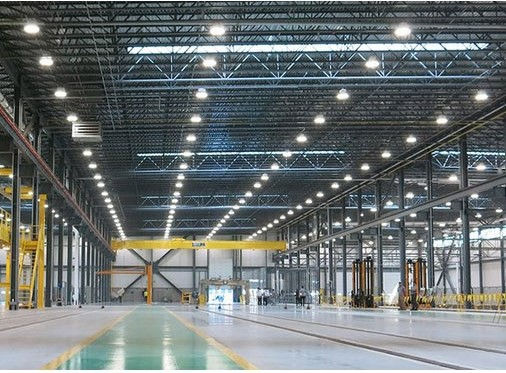
Industrial High Bay lighting is not just a utility bill line item. It is a core pillar of operational safety, workforce morale, and bottom-line efficiency. Walk into any high-performing warehouse, manufacturing plant, or logistics hub, and you will notice one thing immediately: you can actually see what you are doing.
We hereby break down exactly how high bay lighting works, how to calculate your needs, and how to pick the right fixtures for your business.
1. What is High Bay Lighting?
High bay lights are heavy-duty fixtures engineered to illuminate expansive spaces with high ceilings typically anywhere from 15 feet to over 40 feet.
Unlike standard office or residential fixtures, high bays produce high lumen outputs to disburse light down across vast spaces. They deliver bright, uniform illumination while minimizing glare and shadows.
Because they are mounted so high, they need serious luminiscence to push light all the way to the floor without letting it scatter.
When choosing a fixture layout, you will generally choose between two primary shapes:
UFO (Round) High Bays: Shaped like a disc, these lights throw a wide, circular pattern. They are perfect for wide-open spaces like manufacturing floors, open-plan workshops, and commercial gymnasiums. They are incredibly durable and usually hang from a single, sturdy hook, which slashes installation time.
Linear High Bays: These are long, rectangular fixtures. They are the absolute industry standard for high-rack warehouses and fulfilment centres. Instead of wasting light on top of pallets, they project a focused, rectangular beam straight down into narrow aisles so that picking teams can read labels perfectly.
2. The Math: How Many Lights Do You Actually Need?
You do not want your facility to look like a checker-board of blindingly bright spots and pitch-black shadows. To get uniform, safe lighting, lighting engineers use a formula called the Lumen Method.
Choosing the right high bay setup requires balancing mounting heights, beam angles, and complex calculations. This comprehensive guide simplifies high bay lighting so you can design the perfect setup for your commercial space.
Step 1: Know Your Target Lux
Lux measures the actual intensity of light hitting a surface (one lux equals one lumen per square meter). Different jobs require different light intensity levels:
Facility Application | Recommended Light Level |
Bulk Storage / Cold Storage | 100 to 150 Lux |
Active Logistics (Picking & Packing Zones) | 200 to 300 Lux |
Precision Manufacturing & Assembly Lines | 300 to 500 Lux |
Aviation Hangars & Heavy Machinery Yards | 500 Lux+ |
Step 2: The Core Formula
To calculate the exact number of fixtures (n) your space requires, we use this equation:
n = (E X A) / ( F X UF X LLF)
Where
E (Target Lux): The light level your space requires (from the table above).
A (Area): The total floor space of your room in square meters (Length X Width).
F (Fixture Lumens): The raw brightness rating of a single light fixture.
UF (Utilization Factor): The efficiency of the room. It is between 0.6 and 0.8, accounting for how much light is absorbed by your wall colours and ceiling layout.
LLF (Light Loss Factor): A realistic buffer (usually 0.7 to 0.9) that accounts for natural bulb ageing and dust build-up over the years.
3. Height, Wattage, and the Crucial "Inverse Square Law"
Optics features a rule called the Inverse Square Law. Simply put: if we double the height of our light fixture, the brightness on the floor drops to one-quarter. To counter this, we must scale up our wattage as the ceilings get higher. When planning a layout with heavy-duty industrial systems, look at this quick matching guide:
15 to 20 Feet Ceilings: Go with a 100W fixture. It gives crisp, bright visibility without blinding workers on lower ceilings.
20 to 25 Feet Ceilings: Step up to a 150W model to keep your floor crisp and clear.
25 to 35 Feet Ceilings: Use a 200W heavy-duty fixture to punch through the empty vertical space.
40 Feet and Above: Deploy high-intensity 250W modular systems to throw intense, focused light all the way down to the concrete floor.
Selecting the Right Beam Angle
Beam angles control how wide or narrow the light spreads.
Wide Angle (120 degree): Best for open spaces and lower high-bay heights (15-25 ft). It spreads light evenly across a massive footprint.
Narrow Angle (60 degree) or (90 degree): Crucial for high-rack storage (25+ ft). It focuses a tight beam straight down to the floor, preventing the light from being trapped by high pallets.
Optics Matter: Lens vs. Plain Glass
To keep light uniform, pay attention to the fixture's protective face. Lens models use distinct optical paths to focus light downward, making them ideal for high ceilings and narrow aisles. Plain glass models are great for lower, open-plan spaces where you want wide, smooth light.
4. B2B Procurement: Metrics That Protect Your Investment
When writing an RFP or vetting suppliers, look past the initial price tag. Low-quality high bays fail prematurely due to harsh factory environments and power spikes. Instead, the RFPs should be based on these four specifications to ensure a low Total Cost of Ownership (TCO):
Premium Heat Management: Heat kills electronics. Our AlpsGlo high bay lights are built from their fixtures using ADC12 grade aluminium die-cast housings. This heavy metal pulls heat away from the LEDs, allowing them to comfortably cruise past 50,000 hours of operational life.
Modular Repairability: Traditional high bays are sealed units, if the driver dies, the whole fixture is to be replaced. We favour a modular architecture, allowing maintenance team to swap out individual drivers /LED panels, saving thousands in replacement costs.
Ingress Protection (IP65): Industrial plants are dusty, and some require heavy wash-downs. An IP65 rating ensures the light is entirely dust-tight and water-resistant.
Surge Protection: These fixtures have built-in voltage surge protection to isolate the delicate LEDs from sudden electrical grid spikes.
Colour Rendering Index (CRI): For manufacturing, picking, or retail, use a CRI of 80+. Accurate colour definition helps workers read labels and spot product defects easily.
In addition, we at Bithika Innovates also provide repair and maintenance services for these suitable high order luminaires (any brand/model) as per industry standards and at optimal costs, which further allows you to cut cost and manage your unserviceable luminaires inventory load.
Summary: Future-Proofing the Facilities/Wokshops
Upgrading to a smart, modern high bay system changes the entire energy of a business. Workers are safer, error rates drop, and by pairing modern LEDs with simple sensors, you can further slash your facility’s electricity bills by up to 70%.


Comments