


Keeping the Lights On: How Modern and Commercial LED lights costs in the Global Economic Squeeze

Updated: Jul 27
(High Costs of Commercial Lighting Explained)

Let’s face it—running a facility, warehouse, or even managing a commercial budget has felt a bit like walking a tightrope lately. So, Is Your Commercial Lighting Costing You? In this blog we try to explain why the Costs of Commercial Lighting become high. Between rising raw material costs, supply chain disruptions, and erratic global energy markets, every business owner is trying to answer the same question: Where can we cut costs without cutting corners?
When the economy gets tough, the natural instinct is to freeze spending. But smart managers are looking up at their ceilings and finding a hidden ally. LED lighting technology has quietly gone through massive upgrades, shifting from a simple energy-saving upgrade into a critical survival tool for navigating tough economic times.
However, as the global economic crisis puts pressure on manufacturers, a dangerous trend has emerged in the lighting market. To understand how to protect your investment, you need to know how some of the most popular brands are cutting corners—and how modern, genuine LED advancements are helping local businesses protect their cash flow when every rupee counts.
1. The Corporate Compromise: Cheap Drivers and DOB Circuits
To keep their retail prices low during this economic squeeze, many well-known, mass-market lighting brands have quietly changed how their lights are engineered. The biggest casualty has been the LED driver—the internal engine that regulates power to the light-emitting chips.
The Problem with DOB (Driver-on-Board): Many popular companies have completely eliminated independent, heavy-duty drivers. Instead, they use cheap Driver-on-Board (DOB) circuits, where the driving components are crammed right onto the same board as the LED chips. LEDs are current driven components which are greatly effected by heat, yes the same heat that they themselves generate. When we place other components directly beside the heating elements, there performance tends to deteriorate eventually leading to complete failure/burnout. However technology has advanced too far and this deterioration cycle has been delayed until almost one year or may be a little more.
The Hidden Performance Hit: While DOB circuits make the light incredibly cheap to manufacture, they drastically compromise true efficiency. These circuits struggle to handle power surges and generate massive amounts of trapped heat. When the board gets hot, light output drops, and electricity consumption actually increases relative to the brightness produced.
Premature Failure: Because the cheap components sit right next to the hot LED chips, they bake themselves to death. You end up buying a light that claims to last for years, only to watch it flicker and die within the months of warranty (typically 12 months) or even before that due to a fried, low-quality circuit.
2. Doing More with Far Less: The True Efficiency Leap
While mass-market brands cut corners, premium industrial fixtures—some brands focus on true, uncompromised chip and driver technology. Genuine advancements squeeze vastly more brightness out of even lower wattages by using isolated, high-efficiency drivers.
The Economic Impact: When a light uses a high-quality, independent driver, it maintains a superior power factor. This means it draws clean power with minimal waste, directly slashing your lighting power consumption by up to 60% to 80%.
The Reality: In a high-inflation market, lowering your fixed operational costs with genuinely efficient fixtures is the quickest way to inject predictable liquidity back into your monthly budget.
3. Built for the Long Haul: Longevity Over Replacement
The current global economic crisis has made electronics manufacturing and shipping highly unpredictable. Spares are more expensive, and components take longer to arrive. This is where modern design principles—focusing heavily on thermal isolation—come into play.
The Upgrade: Premium fixtures separate the heavy-duty aluminum die-cast housing from an independent, surge-protected driver. This thermal isolation allows the light to safely cross 50,000 to even 100,000 hours of continuous operation.
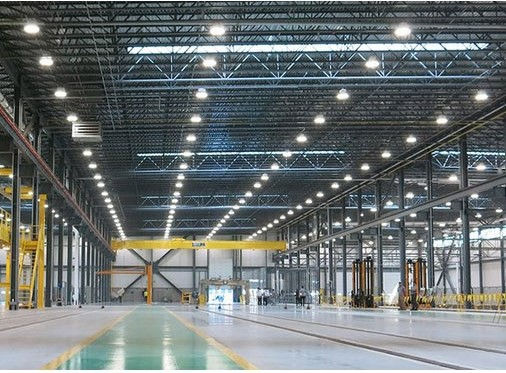
The Human Benefit: Think about the pure frustration and cost of hiring a maintenance crew, renting a scaffolding lift, and pausing factory operations just to replace burnt-out warehouse bay lights caused by cheap DOB circuits. High-end LEDs eliminate that recurring maintenance nightmare entirely, letting your team focus on productive work.
4. Moving Toward the Circular Economy: True Repairability
In a tight economy, the throwaway culture of cheap, mass-produced electronics is officially dead. If a cheap DOB light breaks, the entire fixture is useless garbage.
AlpsGlo LED lights takes the opposite approach. If an extreme voltage fluctuation occurs—a high-quality fixture protects itself. Because the driver is an independent, premium component, local commercial operators can easily replace or refurbish just the driver module or the MCPCB independently. It provides an industry-compliant, warrantied performance refresh at a fraction of the cost of buying brand-new hardware.
The Bottom Line
An economic crisis forces us to look closely at inefficiency. Do not be fooled by cheap upfront prices or blindly from brands relying on low-grade DOB circuits that inflate your electricity bills and burn out prematurely. Lighting shouldn't be a passive utility bill that you dread opening every month. By investing in heavy-duty fixtures with isolated, premium drivers, you aren't making an expense—you are building a defensive shield for your bottom line.




Comments